20
English Chalice. He replied that he could not believe this
manuscript had been owned by the family in the Middle
Ages because all of the Rookwoods’ books and papers had
been seized by the Crown upon the arrest of Ambrose
Rookwood, a conspirator in the 1605 Gunpowder Plot.
Catholics, led by Guy Fawkes, had planned to blow up
the Houses of Parliament with the Protestant King James
I inside. The historian theorized that the manuscript
had stayed on the continent and been purchased by Sir
Thomas Rookwood during his exile in Bruges in the 1680s.
The style of the book’s binding and the English marginal
additions belied that theory, but the Ambrose Rookwood
information rather undermined my original interest
in the manuscript. Its association with the Rookwoods
seemingly postdated the English Chalice.*
At the end of the call to London, I rushed up to the
17th floor to attend the quarterly meeting of LUMA’s
Board of Advisors. This went quite speedily, focusing
mainly on the museum’s approaching 10th anniversary. I
sit on two committees of the Board—the Collections and
the Facilities and Design committees—but there was little
to report or discuss in either case.
There were a couple of social events during the week
to attend. I gave a tour of the museum to members of the
River North Business Association during their private
reception on Wednesday evening. On Thursday, there
was the members’ opening in the galleries at 5:00 p.m.,
followed by the annual donor dinner in Regents Hall.
The week ended as it began, with crèches. I was due at
the Art Institute at 9:30 a.m. to meet my fellow panelists.
We were taken through “tech check” in Fullerton
Auditorium and then were among the first members of
the public this year to see the Neapolitan presepe. A class
of enthralled school children joined us as we all excitedly
examined and identified the myriad of 18th-century street
characters.
The program itself went off without a hitch. In my
remarks, designed as much to tie together the presentation
of Nativity scenes at LUMA and the Art Institute as the
three papers, I focused on the message inherent in the
original Gospel texts. Different in their details, both
accounts convey a sense of wonder through the inclusion
of dreams, angels, and wandering star and contrast
between the divine and secular, as well as between the the
commonplace (shepherds) with the exotic (Magi). These
are the characteristics to which artists across time and
cultures respond as seen in the Art Institute’s 18th-century
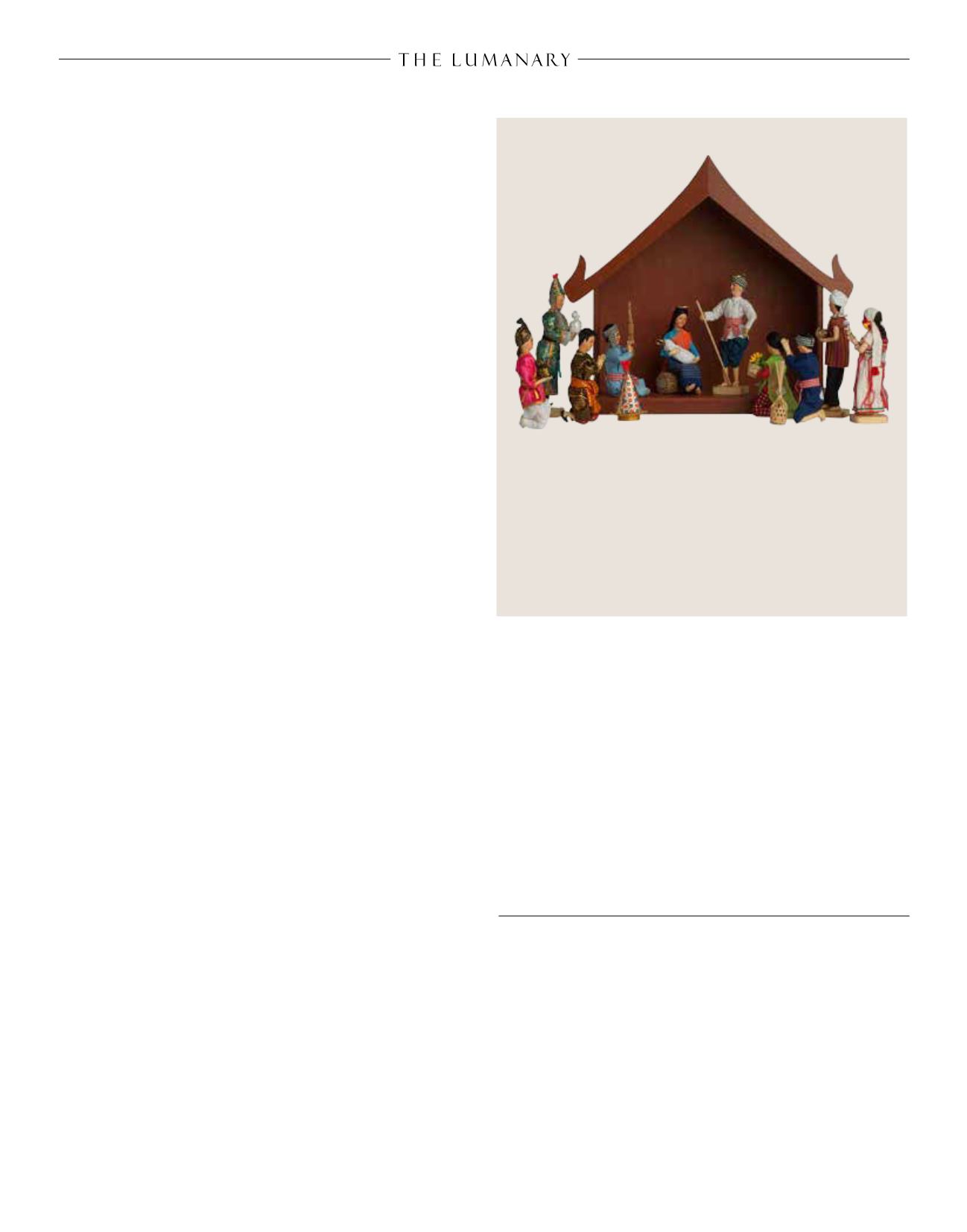
Neapolitan presepe and LUMA’s 20th-centuryThai crèche.
In the latter, I have always liked the contrast between the
farmers, dressed in traditional Karen clothing, and the
Magi, dressed in silks asThai, Chinese, and Indian nobility.
Fortunately, according to both calendars, Saturday is a
day off at the end of the week.
*As one of our Collection Committee members put it to me in the
following week, the Catholic history of the piece did not make up for its
shortcomings as a medieval manuscript. Ultimately, I decided against
bidding for the book. My intern, Frank Walsh, discovered a blogger’s
appeal to save the manuscript for the nation. On December 2, it sold
for a hammer price of £11,000, roughly $21,500. It was purchased by
Cambridge University Library, the repository of much of Sir Thomas’s
library.
Khunying Tongkorn Chandavimol, Thailand, wood, fiber, paper, metal, and
fabric. LUMA, The James and Emilia Govan Crèche Collection, 2013-06-85
“I have always liked the contrast between
the farmers, dressed in traditional Karen
clothing, and the Magi, dressed in silks as
Thai, Chinese, and Indian nobility.”


