“Yet what makes the novel so appealing is the way
Urrea blends the story of Mexican family life and
Catholic devotion into the contemporary realities of
poverty, immigration, prejudice, and genocide.”
22
Page Turners
Reading suggestions by LUMA staff, members, and friends
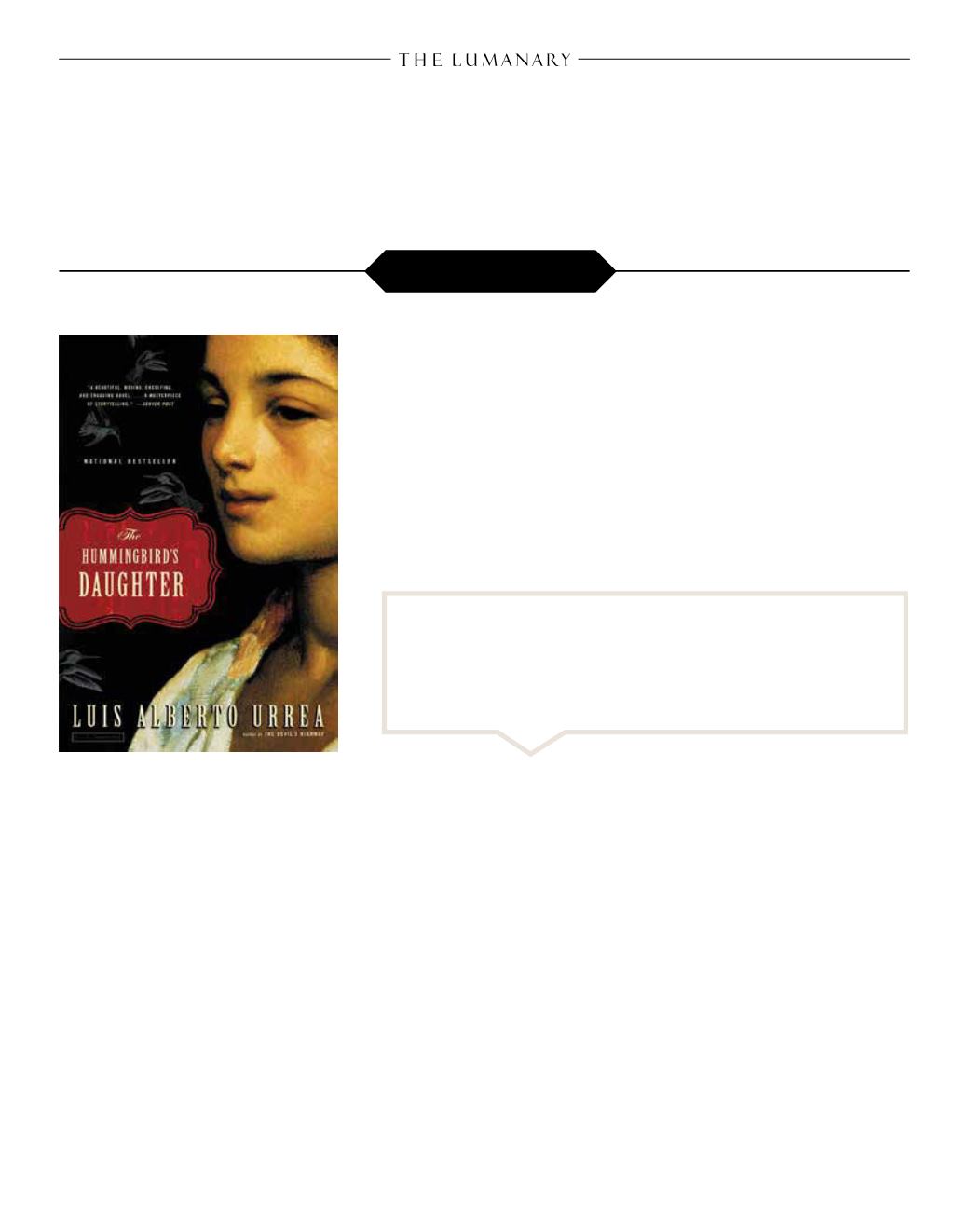
Luis Alberto Urrea’s
The Hummingbird’s Daughter
(2005) is a delight.
Urrea, who grew up along the Mexican/U.S. border and now teaches at
the University of Illinois, Chicago, turns a family folktale into a novel of
beautiful lyricism. The story is based on Urrea’s great Aunt Teresita, known
as the Saint of Cabora or the Joan of Arc of Mexico. Grounded in historical
truth (Urrea spent 20 years researching it) the novel is nonetheless a wildly
romantic work of fiction. We follow Teresita, the bastard child of Don
Tomas Urrea, as she discovers her native gift for healing. Her coming of age
occurs before the backdrop of the tumultuous 1910 Mexican Revolution
that forced the Urrea family to flee to the United States.
Teresita understands her healing powers as a tremendous gift as well
as a terrible burden, causing the chaos that puts her family on the run. Yet
what makes the novel so appealing is the way Urrea blends the story of
Mexican family life and Catholic devotion into the contemporary realities
of poverty, immigration, prejudice, and genocide. Teresita learns the
ancient wisdom and devotion of the Yaquis while under the tutelage of
the teacher and medicine woman Huila; she learns to test her skills with
her father, the “rational” Don Tomas, as they live through the chaos of
modern Mexican history. The reader must negotiate with Teresita the
familial, political, and religious terrain as she grows into what the Mexican
government once called “the most dangerous girl inMexico.” Both realistic
and magical, Urrea accomplishes so much that I can’t wait to read the
sequel,
Queen of America
(2011).
FR. MARK BOSCO, S.J.


